It has been a very dynamic, educational and challenging experience working on the permaculture site as well as continuing the experience in São Paulo with people from the site. I only spent one week actually on the site, but new opportunities have lead us to a project transforming a run-down city park into part of an open university using ideas from permaculture and sustainable living. The group has a meeting tomorrow with the mayor of Carapicuiba (which is basically part of São Paulo, though technically its own municipality), and then we will see if we are going to Brasilia, the capital of Brazil, to meet with the Minister of Education. It is certainly not the kind of experience that I thought I would have going to a farm far outside the city, but it is turning out to be a much more diverse and valuable experience than I could have imagined.
With that said, below is a bit of an introduction to Sítio São Francisco. I also have footage from the Bioconstructing Workshop that Felipe hosted there, but I need some translating help before it can make any sense. Enjoy
Sítio São Francisco from Twenty Twelves on Vimeo.
Monday, April 20, 2009


Thursday, April 16, 2009
Technical Difficulties Technically Not A Problem
It has been an intense week and a half at Sitio São Francisco, a permaculture site in the Quantinga Valley about 2 hours outside of São Paulo city. Besides a day trip to the nearby city of Mogi das Cruzes, I´ve spent the whole time communing with nature in a house in the middle of the woods without electricity or running water. I´ll spare you the details of the banheiro seco or my lack of a shower, but the butterflies don´t seem to mind the natural aromas-

This little guy hung around for a few minutes.
The number 88 is dinstinctly marked on its wings. Crazy.

Eucalyptus frame with bamboo poles running laterally along the roof

This bamboo pole is now on top of the building in the background

Group from the weekend permaculture/Tai Chi workshop building a solar oven
with materials found at the site. More on that later.

This little guy hung around for a few minutes.
The number 88 is dinstinctly marked on its wings. Crazy.
Despite the unappealing details I´ve been really enjoying the experience. The first few days involved intense manual labor cutting down Eucalyptus trees, dragging them down a narrow wooded path then over a hill, stripping them of their bark, cutting them to size with a hatchet, and finally nailing them in place. The structure below (on top of the existing concrete building) uses materials found on the site or recycled from trash. The only materials bought for the building are the nails. An interesting side note that won´t make my mother proud, Felipe (the owner/only permanent resident of the site) and I dug out some useful materials from a city garbage container in downtown São Paulo last night that included carpet and a bamboo laundry basket. The creativity and resourcefulness here continuously amaze me.


Eucalyptus frame with bamboo poles running laterally along the roof

This bamboo pole is now on top of the building in the background
What has been so incredible is the diversity of opportunities to learn new practical skills while actively participating in creating something new or improving something that most have given up on. Watching your efforts become something of tangible value holds such a deep sense of satisfaction. On top of that, the physically demanding days (and absense of city noise, i.e. passing cars or crazy people with slabs of concrete yelling at passing cars) make for some of the best sleep I´ve had in a long time.

Group from the weekend permaculture/Tai Chi workshop building a solar oven
with materials found at the site. More on that later.
We are now in São Paulo city while Felipe collaborates on various projects utlizing his knowledge of permaculture. In the last two days we have met with a family opening a cultural community arts center based around their Capoeira school, a neighborhood reclaiming an unused area to create a park dedicated to education about the African diaspora in Brazil, and the municipal government of Carapicuíba (basically part of São Paulo but not technically) renovating a public park and looking to implement ecologically friendly ideas from permaculture. I happened to stumble upon the most intense and diverse experience one could have in Quatinga...
We are heading to the federal capital of Brasilia next week to meet with an important federal government official. I can´t tell you who...not because I´m not supposed to, but because either I forgot the name or that part got lost in translation. Regardless, my time here is proving to be much more exciting than I imagined. A small glitch that occured tonight is the refusal of my computer to do anything. Luckily we are in São Paulo and Toshiba has an office here that might be able to help. With the way things are progressing, though, it will be nice not to worry about computer details and focus on the more immediate details of how I can be useful. Perhaps my computer crashed to help keep me connected to reality rather than cyberspace.
We are heading to the federal capital of Brasilia next week to meet with an important federal government official. I can´t tell you who...not because I´m not supposed to, but because either I forgot the name or that part got lost in translation. Regardless, my time here is proving to be much more exciting than I imagined. A small glitch that occured tonight is the refusal of my computer to do anything. Luckily we are in São Paulo and Toshiba has an office here that might be able to help. With the way things are progressing, though, it will be nice not to worry about computer details and focus on the more immediate details of how I can be useful. Perhaps my computer crashed to help keep me connected to reality rather than cyberspace.
Sunday, April 12, 2009

Wednesday, April 8, 2009
Language Learning Made Easy with Music
I have met several people in the last few months who amaze me by saying that they learned English by watching movies and/or listening to music. Of course they take a much more active role in listening, but it shows that if the will to learn is there, it will happen without expensive textbooks, fancy libraries or advanced computer programs. All you need is a dictionary and some good tunes, so for anyone interested, here is a fantastic song by Ben Harper and a well-known Brazilian artist named Vanessa da Mata that should help you. The best part about this song is Ben Harper basically sings the translation of the Portuguese lyrics the whole time.
Link to the YouTube video
And the lyrics:
É só isso
Não tem mais jeito
Acabou
Boa sorte
Não tenho o que dizer
São só palavras
E o que eu sinto
Não mudará
Tudo o que quer me dar
É demais
É pesado
Não há paz
Tudo o que quer de mim
Irreais
Expectativas
Desleais
That's it
There is no way
It's over
Good luck
I have nothing left to say
It's only words
And what l feel
Won't change
(Refrão)
Tudo o que quer me dar
Everything you want to give me
É demais
It too much
É pesado
It's heavy
Não há paz
There is no peace
Tudo o que quer de mim
All you want from me
Irreais
Isn´t real
Expectativas
Expectations
Desleais
Mesmo, se segure
Quero que se cure
Dessa pessoa
Que o aconselha
Há um desencontro
Veja por esse ponto
Há tantas pessoas especiais
Now even if you hold yourself
I want you to get cured
From this person
Who advises you
There is a disconnection
See through this point of view
There are so many special people in the world
So many special people in the world... in the world
All you want all you want
(Repete refrão)
Now were falling (falling), falling (falling) into the night (into the night),
Falling (falling), falling (falling) into the night (um bom encontro é de dois),
Now were falling (falling), falling (falling) into the night (into the night),
Falling (falling), falling (falling) into the night.
Thursday, April 2, 2009
Sinking In
Sinking into the local culture and experiencing as much as possible is always my main goal, though this bearded gringo doesn't exactly fit in when walking through the street. Brasil has such a rich cultural diversity that I have been a bit overwhelmed with the variety of flavors, fun times, and filling foods.
Lunch is the main meal of the day here. Most days my friend's family comes home from work to eat a big lunch together. One lunch might have 5 or 6 different dishes to pile on a plate. A few examples of foods that I have had include:
Feijão com arroz - Beans with chunks of meat poured on top of rice
Pão de queijo - cheese bread
Polenta - similar to grits but not as gritty...
Farofa - mixed with...almost anything really
Stroganoff - somehow Russian influence made it into to a delicious, creamy Brazilian dish. I ate it with frango (chicken)
These, of course, are just examples, but the point is that each day is a feast of new flavors. I told my friend and his family that I would be 350 pounds if I lived here.
One of my favorite dishes is camarão na moranga, or shrimp in a pumpkin. I got to help make it when I was in Florianópolis and stumbled across it again in a buffet here in Piracicaba (buffets where you pay by weight are very common here in Brazil). Creating this concoction was just like carving a Halloween pumpkin until they skipped carving the face and starting filling the pumpkin with requijão (a creamy cheese) and shrimp. You bake it in the oven for a couple of hours and then mix the inside of the pumpkin with the shrimp and cheese. Thick, rich, creamy, tasty goodness in a convenient biodegradable bowl. Brilliant.

I didn't take this picture...in fact, I don't know who did,
but it more or less looks like the one that I ate.
My latest experience in Brazilian cuisine was at a rodízio (hoe-DEE-zee-oh), which is where you pay a set price and waiters bring offerings of different foods to the table until you signal that you have had enough. This is rather dangerous in my case, because I don't stop until I've tried everything. More specifically, we went to a churrascaria that serves various kinds of meat delivered on giant skewers. The waiters then slice off pieces for you at the table as you pluck them off the skewer with little tongs. They had at least six different cuts of beef, four or five different types of sausage (unfortunately no blood sausage, I miss Argentinian morcilla), a thick white fish that I can't remember the name of, white and dark meat chicken, and even chicken hearts. I wasn't very fond of the latter - too tough and chewy, but my friend who took me to the rodízio loved them.

The menu explained the seven main cuts of beef that they serve.
My favorites were picanha and cupim.

Picture on the front of the menu is none other than picanha.
On a final note, my Portuguese is coming along (I don't know if I would say quickly), but I'm still having trouble with some of the sounds, in particular the ão sound. It is a deep nasal sound that doesn't occur in English, that I can think of, but is frequently used in Portuguese. I'll use another reference to Fernando Pessoa's poetry to illustrate how common this sound is used and therefore how often people look at me funny when I try to pronounce it:
Feijão com arroz - Beans with chunks of meat poured on top of rice
Pão de queijo - cheese bread
Polenta - similar to grits but not as gritty...
Farofa - mixed with...almost anything really
Stroganoff - somehow Russian influence made it into to a delicious, creamy Brazilian dish. I ate it with frango (chicken)
These, of course, are just examples, but the point is that each day is a feast of new flavors. I told my friend and his family that I would be 350 pounds if I lived here.
One of my favorite dishes is camarão na moranga, or shrimp in a pumpkin. I got to help make it when I was in Florianópolis and stumbled across it again in a buffet here in Piracicaba (buffets where you pay by weight are very common here in Brazil). Creating this concoction was just like carving a Halloween pumpkin until they skipped carving the face and starting filling the pumpkin with requijão (a creamy cheese) and shrimp. You bake it in the oven for a couple of hours and then mix the inside of the pumpkin with the shrimp and cheese. Thick, rich, creamy, tasty goodness in a convenient biodegradable bowl. Brilliant.

I didn't take this picture...in fact, I don't know who did,
but it more or less looks like the one that I ate.
My latest experience in Brazilian cuisine was at a rodízio (hoe-DEE-zee-oh), which is where you pay a set price and waiters bring offerings of different foods to the table until you signal that you have had enough. This is rather dangerous in my case, because I don't stop until I've tried everything. More specifically, we went to a churrascaria that serves various kinds of meat delivered on giant skewers. The waiters then slice off pieces for you at the table as you pluck them off the skewer with little tongs. They had at least six different cuts of beef, four or five different types of sausage (unfortunately no blood sausage, I miss Argentinian morcilla), a thick white fish that I can't remember the name of, white and dark meat chicken, and even chicken hearts. I wasn't very fond of the latter - too tough and chewy, but my friend who took me to the rodízio loved them.

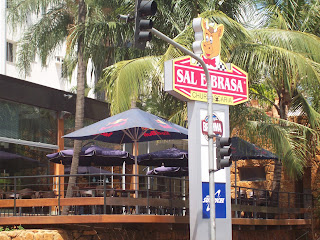
The name of the restaurant:
Salt and Hot Coal
Salt and Hot Coal

The menu explained the seven main cuts of beef that they serve.
My favorites were picanha and cupim.

Picture on the front of the menu is none other than picanha.
Os campos, afinal, não são tão verdes para os que são amados
Como para os que o não são.
Sentir é estar distraído.
The fields, after all, are not as green for those that are lovedPretty deep, huh? Deep like the nasal sound you have to make to say the ão sound. While my attempts to speak Portuguese may well be struggling to stay afloat, I am planning my next attempt to sink further into the culture and force myself to learn the language - a month on a farm. It is about as far away from the tourist track as you can get, so I'm going. Faló!
As for those that are not.
To feel is to be distracted.
Wednesday, April 1, 2009
Useful Days
Weekdays in Portuguese are called dias úteis (literally 'useful days' - though everyone knows weekends are always more useful) and rather than having names based on pagan gods or planets like the rest of the Romance languages as well as in Germanic languages, the days of the week are numbered. This apparently follows the Latin terms for Easter week. Sunday, the first day of the week, is dies Domenica (literally Lord's Day) in Latin or Domingo in Portuguese. The next day, Monday, becomes the "second day of rest" (again, in observance of Easter week) and therefore Segunda-feira. The word feira in Portuguese means 'fair' and the closely related word férias means 'vacation'. I think it is a bit ironic that the dias úteis would refer to the days we should not work.
Portuguese - English
Fim de semana = Weekend
Domingo = Sunday
Sábado = Saturday
Dias úteis (literal translation)= Weekdays
Segunda-feira (Second fair) = Monday
Terça-feira (Third fair) = Tuesday
Quarta-feira (Fourth fair) = Wednesday
Quinta-feira (Fifth fair) = Thursday
Sexta-feira (Sixth fair) = Friday
I suppose I should go out and take advantage of the rest of this useful day.
Tuesday, March 31, 2009
Crisis Ministries Video
So, in an effort to begin catching up on the video that I have taken, here is the video about my experience in Charleston, SC before I left for South America...back in November 2008. Thanks again to Crisis Ministries!
Tuesday, March 24, 2009
Two weeks in Brazil...I mean, duas semanas no Brasil
Just over two weeks ago, Brazil was a frightening prospect. It promised a nerve-racking border crossing complete with full bag inspection and dark room interrogation, an even worse language barrier than in Argentina and Uruguay (since I theoretically speak Spanish and couldn't even count to ten in Portuguese), and a crime rate that assures each visitor a blind-folded minivan ride before the end of the first week. After seeing the Brazilian movies City of God (Cidade de deus) and The Elite Squad (Tropa de Elite), I started to wonder if the entire country was one giant lawless favela. The State Department Travel Information wasn't helping to allay my fears, though it rarely does. I did find some reassurances amidst the doom and gloom:
Considering I have only 5 t-shirts and 3 pairs of shorts, one of which is a swim suit, and laundry gets done every 2 to 3 weeks, there is really no other option than to "dress down". The next step down is not showering, and I don't think that is necessary, though it does happen from time to time. Basically I should try and avoid looking like a tourist with money. My question is, does this look like someone with their act together?

Very poor neighborhoods known as "favelas" ... are sites of uncontrolled criminal activity and are often not patrolled by police. U.S. citizens are advised to avoid these unsafe areas.
All joking aside, it really is important to take into consideration the travel warnings and stories of crime and social disorder when traveling through an area. On the other hand, you cannot let all the possible bad things that could happen to you keep you from going. New York can be pretty scary, but it's worth a visit.

R$ 2, or about US$0.90, for the whole bunch! That's like 3 cents per banana!
That smile was a simple thank you, but it held a certain degree of contentment that made me wonder about her way of life and how happy it makes her. There is no one right or wrong way to live. If the goal is to be happy, who is to say what way of life brings that about? We are predisposed to thinking that these people are less fortunate than us, but that judgment depends on how you define success. We would assume that someone who collects cans for a few cents each is not financially successful, but if she has her basic needs met and is content with having nothing more, then she must be successful. My point is that I don't know because without a common language, I had no way of knowing anything more about her, but the experience made me reevaluate some assumptions. I found a poem by Pessoa that might shed some light:
Travelers should "dress down" when outside and avoid carrying valuables or wearing jewelry or expensive watches.
Considering I have only 5 t-shirts and 3 pairs of shorts, one of which is a swim suit, and laundry gets done every 2 to 3 weeks, there is really no other option than to "dress down". The next step down is not showering, and I don't think that is necessary, though it does happen from time to time. Basically I should try and avoid looking like a tourist with money. My question is, does this look like someone with their act together?

After pondering this for a few moments, I came to the conclusion that they are just saying use common sense. For example, if you see someone carrying a big automatic weapon, don't walk towards them; walk away. Fortunately my mom instilled in me a healthy sense of precaution, maybe not as much as she would like, but enough to keep me from putting myself in certain senseless situations.
All joking aside, it really is important to take into consideration the travel warnings and stories of crime and social disorder when traveling through an area. On the other hand, you cannot let all the possible bad things that could happen to you keep you from going. New York can be pretty scary, but it's worth a visit.
In contrast to my initial fears, I slept through the border crossing while the bus company dealt with border formalities for both Uruguay and Brazil, the only guns I've seen were in the hands of armored truck guards transporting money to and from an ATM (which I feel is normal enough), and I have managed to pick up enough Portuguese to buy bananas on the side of the road.


R$ 2, or about US$0.90, for the whole bunch! That's like 3 cents per banana!
I spent my first week in the comfort of a hostel where English was spoken. Most hostels, especially in touristy areas, have English-speaking staff. I wanted to ease into needing Portuguese to acquire the essentials for a sustainable existence. It has its other benefits as well. One of the best things about the hostel scene in tourist spots is the incredible diversity of people and points of view from all over the world. Here is a condensed list of the people I met while in Florianópolis: droves of Argentinians, a few Isrealis, an Italian geologist on vacation, Australians, an Austrian who lives in Brazil for half the year, a group of young English chums, an Irish dentist who gave me a much-appreciated free consultation on my impacted wisdom tooth, a Dutch girl that I first met in Bariloche back at the beginning of February, two sweet Swedish girls, a smily middle-aged Swiss arquitect, a Portuguese guy, a German with dreadlocks, a Japanese cyclist who had been traveling by bike for the last year and a half starting in Canada, a multilingual French guy who ended up being my adventure guide and translator for the first few days, and of course Brazilians. By the way, the Brazilians that I have met generally seem to be jolly, kind, giving people. One of the reception workers at the hostel who is from Floripa offered me a free lesson in Portuguese and gave me a book of poetry by one of Brazil's most beloved poets, Fernando Pessoa. It has been a useful and enjoyable study tool. It is also probably essential to my ability to buy those bananas on the road trip from Florianópolis to Piracicaba. So, a big thanks to Flavia.

Fortunately, I have found that I can get by with Portuñol here, a rough mix of Portuguese and Español (Spanish). I have even resorted to speaking straight Spanish when I have no clue in Portuguese, and most of the time I can make myself understood with the help of lots of gestures. It is frustating though when you want to communicate ideas more complex than 'I need food' and 'I need a bathroom'. Discussing social inequality or the role of television in shaping society using only gestures just doesn't get the whole point across. I did manage a short conversation about the latter where our common language was gestures and noises. It consisted mainly of making circles with the index finger around the temple, which is the international sign for 'crazy', and walking like a zombie, also internationally understood by sticking your arms out in front of you as you groan and stiffly stagger forward.
One of the times that I really wanted to know the language was in the center of Lagoa da Conceição in Florianópolis. Bars, restaurants, hotdog shops and pastelerías line the main road, and people pour out onto the streets accompanied by live music flowing from the open-air bars. I noticed a number of people roaming about picking up cans and rummaging through bins for other recyclables. After noticing it in the center that night, I continued to see the same thing in many bus stations all over the island. I assume cans are worth a few cents each, and I wondered if these people survive completely by collecting them. One night I put some cans from my hostel in a plastic grocery bag and took them with me to the center. I handed them to the first person I saw collecting cans. She was a short lady perhaps in her late 50s with a kind, tranquil face and thin silver hair almost to her shoulders. When I first offered the bag, she stopped and gave me a baffled look, I'm sure wondering what this strange bearded foreign dude was handing her. When she realized what was in the bag, she accepted with a warm, squinted smile and continued on with her search.That smile was a simple thank you, but it held a certain degree of contentment that made me wonder about her way of life and how happy it makes her. There is no one right or wrong way to live. If the goal is to be happy, who is to say what way of life brings that about? We are predisposed to thinking that these people are less fortunate than us, but that judgment depends on how you define success. We would assume that someone who collects cans for a few cents each is not financially successful, but if she has her basic needs met and is content with having nothing more, then she must be successful. My point is that I don't know because without a common language, I had no way of knowing anything more about her, but the experience made me reevaluate some assumptions. I found a poem by Pessoa that might shed some light:
Un dia de chuva é tão belo como um dia de sol.Fortunately, this is close enough to Spanish that I can offer a translation:
Ambos existem, cada um como é.
A day of rain is as beautiful as a day of sun.-Fernando Pessoa
Both exist, each one as it is.
Saturday, March 7, 2009
Uruguay In A Week
I arrived in Colonia del Sacramento, a famous historical town in Uruguay across the river delta from Buenos Aires, a week ago tomorrow. Three days in Punta del Diablo followed by two and a half in the capital, Montevideo, and already I have to leave. Last night my new Uruguayan friends invited me to stay with them here in Montevideo, and if it were not for the looming 90 day expiration of my Brazilian visa, I would likely take them up on the offer. As it is, however, I board a bus at 9:30 tonight and endure an 18-hour ride to Florianópolis, Brazil.
With so little time in the country, I had to soak in as much as I could of Uruguayan culture in a short amount of time. Last night I went to see a murgas show, which is part of Uruguay´s celebration of Carnaval. Murga is "musical theatre" (in the accurate words of Wikipedia) that provides political and social commentary in an extravagant form. While I did not understand everything the groups sang about, I often heard "yanqui" (people from North America) and "Obama", which shows how much American culture and politics affect people all over the world. While our policies and culture were a common topic to touch upon, the groups obviously did not sing exclusively about yanqui things. They provided social commentary on a plethora of topics related to Uruguayan politics as well as South American policitics in general. They made some very poignant observations, not that I understood what they said, but judging by the crowd's reactions, their commentaries were accurate depictions of the Uruguayan mentality.
On another political note, the president gave an address in a plaza in downtown Montevideo, and according to one of the Uruguayan workers at my hostel, large protests were anticipated. I will try and explain what I understand of the situation:
In the 1970s, many governments here in South America fell under violent military dictatorships: Argentina, Uruguay and Chile especially. The governments of these countries kidnapped, tortured and killed thousands of people who came to be known as los desaparecidos or "the disappeared ones". Before losing power, the military government here in Uruguay passed a law making it illegal to persecute those government officials responsible for the murders and violations of human rights. All military files regarding this time period remain confidential (Check out this picture and the following two from Córdoba, Argentina that show the names of victims from this era in the form of a fingerprint - you can also see the years in which they disappeared).
The current leftist government (let´s not get too wrapped up in the word "leftist" - you can be leftist and not be extreme) promised to revoke that law and seek retribution but has done nothing since taking office. When government officials do not keep their promise here, the people unite and protest. Banging pots and pans during the president's address is a common form of protest. Another method of protest someone described to me is turning off all the lights in the city at night. This seemed particularly benign, but after thinking about it, it seems like a rather poetic form of protest. It doesn't really affect the politicians directly, but it shows that the people are united. I can't imagine all the lights going off in Washington, D.C. or New York to protest a lack of political action, though I would love to see such a show of solidarity in the U.S.
With that said, I had to see for myself what the president's speech would be like. Would there be banging of pots and pans, angry protestors , riot police? Travelers are typically advised to stay away from political events, but I nevertheless found myself walking to the center of town with some Uruguayan university students to a political rally. In contrast to what I heard, there was lots of flag waving and supportive chanting rather than banging of pots and pans. I was also surprised with how close spectators were allowed to get to the president. At one point, I was less than 25 meters from the stage!
Thanks to my friends María and Fede for showing me some authentic Uruguayan culture and giving me a taste of the democratic process as manifested here in Montevideo. If I could stay longer I would.
Next, Brasil.
Felicidades
Saturday, February 28, 2009
Priceless Patagonian Experience
Extending our stay at the Centro de Educación Integral (CEI) San Ignacio (part of the Fundación Cruzada Patagonica organization) in Junín de los Andes proved to be the best decision we could have made. Even after the end of our extra week, we were just beginning to get to know the students and understand the overall functions of the school. Naturally all volunteer projects differ, but it seems that two weeks is a minimum amount of time needed to get the feel for a place, figure out what is needed and how to be of help, and make a meaningful connection with the people. During our time at the school, we were able to accomplish a number of tasks that were mainly focused around outdoor manual labor such as pulling weeds, cleaning and organizing areas around the school, and building a shed for their recycling center. The latter will certainly be our lasting legacy to the school. Even though it is not the finest, sturdiest building, nor an exercise in precision, we were proud to be of help in its creation. We would like to send out a big "Gracias" to our mentor Don Segundo. Even though we couldn't understand what you were saying to us, your assistance, patience, and amusing chuckles made the process quite enjoyable.
 One of our tasks consisted of sorting through a room full of loose papers and books to salvage the good books and trash the rest.
 With the help of some of the other volunteers, we completely cleared the room and salvaged this pile of books along with about three boxes.
---
 One of our more regular tasks included pulling weeds or 'yuyos'.
 While some of the weeds look quite beautiful up close...
 ...they all seemed to have spines that easily penetrated gloves.
 Speaking of gloves, thanks MaB for my Christmas gloves! They got so much use during our two weeks at CEI that they were reduced to bedraggled rags.
---
 The majority of our time was spent working on the recyling shed. We had to improvise quite a bit, which meant using our head. I took it literally.
 We finally got the roof on our creation on the last day at the school. PJ and I were quite satisfied and relieved to have finished before we had to leave...
 ...though a bit sick of each other's company, haha. I'll miss you buddy!
 It may not look like much, but it will serve its purpose - mainly covering all the trash that is sitting out in front.

Apart from the work that we did, just living on campus is a unique experience that I really enjoyed. Volunteers get the chance to explore the local area at times as well. Weekends are pretty relaxed, and volunteers can head into downtown Junín de los Andes, hit up nearby San Martín de los Andes for some hiking or camping, or just relax by the Chimehuin River that runs just behind the campus. The volunteer house is comfortable and has a kitchen, refridgerator, hot showers, and an incredible view from the backyard.
 The view from our room included our little backyard, some cow pasture, and volcano Lanín in the distance.
 I took this picture after wandering out into the cow pasture behind our house in sandals...I wouldn't recommend doing that unless you have to get a picture with a volcano and two eagles perched atop opposing trees.
 One of our tasks consisted of sorting through a room full of loose papers and books to salvage the good books and trash the rest.
 With the help of some of the other volunteers, we completely cleared the room and salvaged this pile of books along with about three boxes.
---
 One of our more regular tasks included pulling weeds or 'yuyos'.
 While some of the weeds look quite beautiful up close...
 ...they all seemed to have spines that easily penetrated gloves.
 Speaking of gloves, thanks MaB for my Christmas gloves! They got so much use during our two weeks at CEI that they were reduced to bedraggled rags.
---
 The majority of our time was spent working on the recyling shed. We had to improvise quite a bit, which meant using our head. I took it literally.
 We finally got the roof on our creation on the last day at the school. PJ and I were quite satisfied and relieved to have finished before we had to leave...
 ...though a bit sick of each other's company, haha. I'll miss you buddy!
 It may not look like much, but it will serve its purpose - mainly covering all the trash that is sitting out in front.

Our man Don Segundo. Thanks so much jefe!
---
Aside from our manual labor tasks, we also had the opportunity to work with the students during study hour from 8:00 to 9:00 PM on weekdays. Exams happened to coincide with our visit, so hopefully our assistance with English studies helped ace some tests. It was a nice mixture of elements to have outdoor tasks, some even related to farm work, as well as opportunities to help out with academics at the same location.---
Apart from the work that we did, just living on campus is a unique experience that I really enjoyed. Volunteers get the chance to explore the local area at times as well. Weekends are pretty relaxed, and volunteers can head into downtown Junín de los Andes, hit up nearby San Martín de los Andes for some hiking or camping, or just relax by the Chimehuin River that runs just behind the campus. The volunteer house is comfortable and has a kitchen, refridgerator, hot showers, and an incredible view from the backyard.
 The view from our room included our little backyard, some cow pasture, and volcano Lanín in the distance.
 I took this picture after wandering out into the cow pasture behind our house in sandals...I wouldn't recommend doing that unless you have to get a picture with a volcano and two eagles perched atop opposing trees.
All in all, our time with CEI San Ignacio turned out to be a very positive experience. My biggest lesson has been in regards to how much time I spend with volunteer projects. I spent a week or less at the first three volunteer projects I worked with in Argentina and didn't have enough time to really have an impact or understand the organizations. I leave Argentina tomorrow for Uruguay, and my challenge is going to be how to implement this new knowledge. Knowing I need to spend more time with the organizations that I choose while still keeping to some kind of schedule adds a degree of difficulty in logistics. It wouldn't be an adventure if it were easy.
There are a lot more pictures from my time in Junín de los Andes with Cruzada Patagonica and the school here:
Pictures from a trip to a Mapuche community where Cruzada Patagonica works.
More Pictures from CEI San Ignacio
I also have pictures up from the other organizations that I worked with while in Argentina:
Plan Techos (Buenos Aires)
Voluntario Global (Buenos Aires)
CILSA (Santa Fe - I didn't take many pictures...)
I hope to be able to write a more thorough account of my experience with these three organizations soon, but for now I'm on the move - three-hour ferry across the river delta to Uruguay early tomorrow morning for my first border crossing.
Saturday, February 14, 2009
Less Is More
My buddy PJ and I arrived in a small Patagonian town called Junín de los Andes last Sunday with the intention of working with an organization called Fundación Cruzada Patagónica for five days. They run a number of programs including rural development and a school called Centro de Educación Integral (CEI) San Ignacio where students receive secondary education free of charge. The school provides an education a well as food and shelter for nearly 200 students at a time. Beyond basic courses such as mathematics, history, language, and science, the school is also an Agro-Technical Secondary School that sits on a large plot of land where pigs, sheep, llamas, etc are raised and many vegetables are grown. Students graduate as "Professional Technicians in Agricultural Production". In other words, CEI is as much a farm as it is a school.
After two days of volunteering at CEI, PJ and I reevaluated our original plan for traveling through Patagonia. After our five days at the school we had planned to head south and hit a number of spots of interest on our way to "El Fin del Mundo" - "The End of the Earth" - a town called Ushuaia that sits at the very bottom of the contitent. Not only is it very difficult to get to, but it costs more money and time than we were willing to surrender. If we were to take a bus directly from Ushuaia back to Buenos Aires, which very likely would have happened due to our time constraints, the ride would last three entire days!
As we sorted out the details of the journey south, we saw Ushuaia and our chance to cross the Magellan Strait (PJ´s namesake) begin to slip through our fingers. We decided that spending another week at the school would be a more meaningful experience (not to mention exponentially less costly) than passing through five guidebook-suggested destinations on the way to Ushuaia. Two weeks of volunteering allows us to better get into the flow of life at the school and figure out how we can be of help. This is something that I have come to realize in the last month and a half of traveling and finding organizations to work with here in South America. I originally envisioned working with as many organizations as possible to share a very wide range of experiences and get the word of these organizations out to other people. It is impossible, however, to acquire even a topical understanding of the issues these organizations address in a matter of days - even two weeks only begins to scratch the surface. It seems the most important lesson I´ve learned so far is that seeing less means doing more.
I have lots of pictures and some video from the last few weeks that I want to get up, but the only access I have to Internet is through locutorios (Internet shops) here in the center of town (which is 7 km away from the school). Bear with me and I should be able to get a lot of material onto the website after the end of our stay here.
P.S. Happy Valentine´s Day (they don´t seem to celebrate it here)
Tuesday, February 3, 2009
A Welcomed Rainy Day - Not Just For Me
To a traveler, rainy days can often be a nuisance preventing sightseeing or ruining outdoor excursions. The last few days in Santa Fe brought almost daily showers and an impressive electrical storm on Friday night that kept me indoors. It was actually a nice break to stay in and spend time with my new friends in Santa Fe while enjoying some home-cooked food and popular Latin American music (I still have a cheesy but very catchy Reggaeton song stuck in my head - "Te amo" by Macano).
Besides my enjoyment of a few relaxing days and a break from the heat, the real reason that the recent rain is a blessing is the drought (la sequía) that has seriously affected the country. Every day the newspapers here print another story discussing the effects of the drought or what government officials or the farmers association are doing in response to the crisis. Livestock and crops are dying leaving few options for farmers throughout the country, and what is worse is that the drought is affecting most of the country rather than a localized region.
Below are a few recent articles about the crisis:
Argentina declares drought crisis, BBC News Article January 27, 2009
Cow skulls and dust: Drought grips Argentina, International Herald Tribune Article January 23, 2009
Subscribe to:
Posts (Atom)